Contact us via the contact page.
Ask your question here
As a manufacturer of packaging we often use jargon, specific to the sector. For outsiders it's not always easy to follow this specific language. Therefore we have bundled a number of frequently asked questions and questions in a clear overview.
Click on 1 of the following questions to find out our feedback. In case you still have an unanswered question, don't hesitate to contact us. The most easy way to do so, is by clicking on the button "Ask your question here" on the right side of this page. We will try to help you asap!
Most of our plastic products are made of polyethylene, also called polyethene (PE). Polyethylene is produced through the polymerization of ethene. Ethene is obtained through the breaking or cracking of raw gasoline, a light derivate of crude oil. PE is shipped in grains, also called granulate.
It's estimated that only 1% of the exploited petroleum oil is needed for the world production of polyethene. This raw material is strong, isolates well and bears the tropical warmth as well as the extreme cold.
At the production process, polyethylene can be given already certain properties. The fabrication of polyethylene with low pressure, gives it a high density (HDPE or PE-HD). The production of polyethylene with high pressure leads to low density (LDPE or PE-LD).
Recycling polyethylene works perfectly. Because it's a thermoplastic material, the raw material can be melted and reused almost infinitely. When the PE carrier bags end in the incinerator after use, the released energy makes an excellent fuel.
The most important types of film that we process are: LDPE, MDPE and COEX.
Low Density Polyethylene (LDPE) is a shiny and flexible material that is transparent by default. In general polyethylene is white coloured, which will have a dynamic result on the print colours. This polyethylene can be coloured in other colours upon demand. Other minimum quantities and a price supplement will be applied.
Medium Density Polyethylene (LDPE) has a matted outlook and is more stiff than LDPE. MDPE is semi-transparent by default and has the look of lime paper. Like LDPE, MDPE can be coloured in white or in another colour.
COEX or coex film consists of several layers of polyethylene. Thanks to coextrusion it's possible to combine the advantages of various materials. To make a film with 2 different sides is no longer unthinkable. Matt/shiny, matt/flexible, shiny/stiff, white/blue, blue/grey, etc. are just a few examples.
Our bioplastics are made of a mixture of plantbased starch (e.g. corn) and biodegradable polymers (biopolymers). The film feels soft and flexible and is qua look comparable to conventional polyethylene. This bio foil is guaranteed to be GMO-free and is exclusively manufactured with cornbased starch of European origin.
Flexographic printing (flexo in short) is a printing process at which flexible printing plates made of plastic (previously: rubber) are being used. Flexography is a frequently used printing process in the packaging industry in order to print flexible materials like plastic, paper, films, etc. Actually it is a kind of relief printing in which the printed image is higher than the non-printed part, like the principle of a stamp. We generally speak about printing plates, sometimes also about polymer plates or stamps.
Bleed printing refers to printing that goes beyond the edge of the packaging. For bleed printing one have to take into account a border of +- 1 cm around the standard size.
There is no scientific evidence suggesting that the plastic bag solution is worse from an environmental perspective when compared to paper bags. About the same amount of energy is used to produce the plastic bags. A plastic bag takes up less space and only weighs half of a paper bag. This is an advantage in terms of transportation. Plastic bags are more durable than paper bags. The recycled plastic bag contributes to reducing the amount of plastic wasted.
The terms biodegradable and compostable are often mixed up. Nevertheless there's a difference between both names. A biodegradable product can be broken down by microorganisms but this does not necessarily imply that the product can be converted into good quality compost.
Since 1 July 2009 in Belgium it's no longer allowed to call a packaging or part of the packaging to be biodegradable (Belgian Law 24 October 2008). The reason for this limitation has everything to do with the possible confusion of the end users. The consumer could think that a biodegradable packaging can be left in nature and would disappear on its own. To prevent this confusion, the Belgian government prohibits the announcement of biodegradability on the packaging itself. On the other hand it's possible to claim that a certain packaging is compostable. These rules are currently only applicable in Belgium but possibly other European member states will follow the Belgian approach.
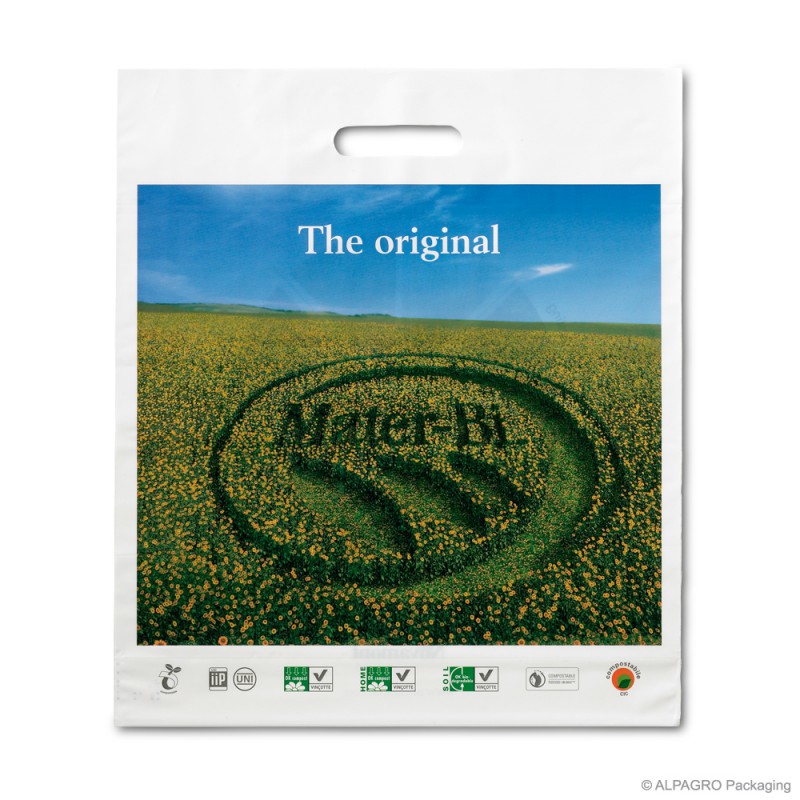
Our certified bio packaging are labeled with at least the OK compost logo. You can find an example of this label at the bottom of the page about certificates. The OK compost HOME logo is similar, apart from the notice "HOME" (see left side of OK compost HOME logo). A product is only certified properly in case the S-code is mentioned on the logo. This S-number refers to the license holder of the product and guarantees the authenticity of the compostability claim. Thanks to this code Vinçotte can trace the product and take the necessary steps in case of misuse.
The same tests are being done for an OK compost and an OK compost HOME certificate, just the temperature and the period of testing are different. An OK compost packaging only breaks down at temperatures of 55 to 60° (solely possible in an industrial composting facility) whereas OK compost HOME materials already break down at lower and less constant temperatures as they appear on a compost heap in your garden.
To comply with the European Norm about compostability of packaging (EN 13432) 4 components are being examined:
Contact us via the contact page.
Ask your question here